自然 · 物理评论:从网络鲁棒性到网络瓦解问题

导语

推荐语
祁明泽
网络鲁棒性和瓦解问题研究主要关注网络结构连通性(最大连通片)面对不同节点失效的变化,而实际上节点之间的失效经常不是独立的。级联失效刻画网络中节点损伤之间的动力学过程,文章总结了多层相互依存、阈值模型和过载模型三种不同研究方法,其中节点的失效分别通过相互依存关系、集体行为影响和负荷重分配来造成其他节点失效。文章同样给出了防止和应对网络崩溃的已有研究,包括鲁棒性设计、早期预警指标、自适应响应和修复等。由于该部分涉及到节点失效后功能的恢复与重构,因此研究者也常常将其称之为网络韧性(Network Resilience)问题。

论文题目: Robustness and resilience of complex networks 论文地址: https://www.nature.com/articles/s42254-023-00676-y
目录
一、引言
二、背景信息
三、与渗流理论的联系
四、最优渗流和网络瓦解
五、级联失效
六、防止和应对网络崩溃
七、展望
-
在生物学、社会学和工程学等领域,复杂系统可以通过交互网络中单元间的信息交换来定义,展现出如异质性、模块化和层级等多样的结构模式。
-
由于复杂网络的相互连接特性,它们能够将微小的干扰放大至整个系统层面,因此理解它们在面对外部扰动和内部故障时的鲁棒性至关重要。
-
研究复杂网络的鲁棒性和韧性涉及探讨通常依赖于度值连通性、空间嵌入、相互依赖和耦合动力学等特征的相变现象。
-
网络科学提供了一系列理论和计算方法来量化系统对扰动的鲁棒性,并提供了基础方法来设计鲁棒性、识别早期预警信号和制定适应性响应。
-
这些方法在系统生物学、系统神经科学、工程学以及社会和行为科学等多个学科中都有应用。
一、引言
一、引言
二、背景信息
二、背景信息
三、与渗流理论的联系
三、与渗流理论的联系

图1 渗流作为网络鲁棒性的静态方法。a、由于根据预定义的移除协议Φ选择了一些节点(灰色节点),网络解体。干预的结果是网络分裂成三个连通片,它们的大小分别为S1、S2和S3。这些簇大小是渗流研究中的一个核心量。b-d、Φ的性质与控制参数相关,严重影响网络的响应,导致最大连通片大小的不同类型的相变。e、具有均匀和异质连接模式的网络(粗略地说,度分布的二阶矩与平均值的平方相当或远大于平均值)对故障和有针对性的攻击的响应方式。圆圈代表连通分量,其半径取决于其节点数量。每个垂直列假设删除相同数量的节点或链接。e部分改编自参考文献[225]。
 和
和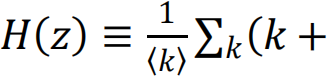
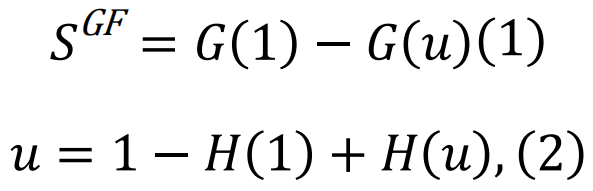
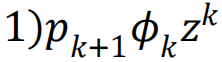 是度分布和剩余度分布的生成函数。(超额度(excess degree)是一个节点随机选择的邻居的连接数减一。)〈k〉表示平均度。网络瓦解点由相应的方程给出。类似的方程也可以用于随机连边故障的情形[93]。通过这些方程,我们可以轻易验证在座渗流(移除节点)和键渗流(移除链接)中,瓦解点的位置是一致的。值得注意的是,只要网络中的连接模式不是特别异质,刻画相变的临界指数也是一致的,并且它们与网络无关,等同于平均场预测[76]。然而,这些结果不适用于更异质的网络:例如,在无标度网络中,普适性等价性被打破[94],且临界指数可能依赖于度分布的指数[85]。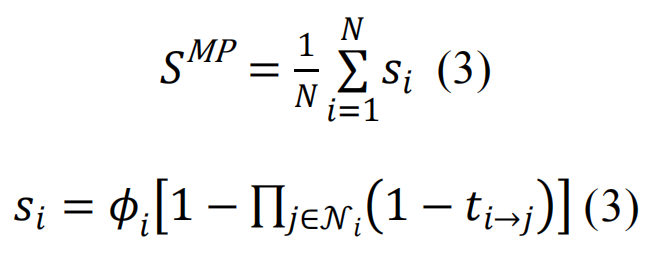

 表示节点的邻域,节点j通过(有向)消息的形式将属于最大连通片的概率传递给周围节点,
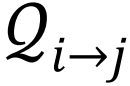 代表接受到节点j传递消息的节点子集。通常情况下,
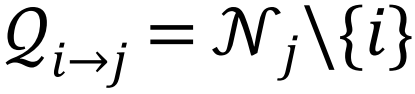 是为了避免回溯信息,尽管考虑短程环路的其他选择也是可能的[102]。在接近瓦解点时,所有ti→j的都趋向于0,所以可以扩展方程(5)得到
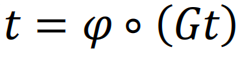 ,其中∘是Hadamard积,
 ,每个Φi出现ki次。G是一个维度为2∣E∣ × 2∣E∣ 的逻辑矩阵,其中 ∣E∣ 是连边数,并且它依赖于
 。瓦解条件由在特征值问题
 中涌现的非平凡解决定,其中
 是Hadamard除法,λ是特征值。Perron–Frobenius定理表明,非平凡解与算子G的最大特征值相关。对于常数占用概率φi=φ,可以得到Φc=1/λmax,其中λmax是G的最大特征值。
四、最优渗流和网络瓦解
四、最优渗流和网络瓦解
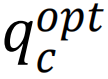 ,使得网络G∞的最大连通分量被最优地瓦解[128]:

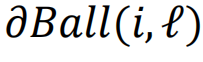 表示以节点i为中心、半径为
 (基于最短路径距离估算)的球体表面。这个算法提供了对最优渗流集的良好近似。后来,基于消息传递[132]和置信度传播(belief propagation)[133]的更好算法被提出,包括去环瓦解[69,134]以及爆炸渗流[64]。这些方法严谨地处理了最优渗流问题,增进了我们的理解,并进一步产生了一系列适用于大规模复杂系统复杂而高效的算法。
 对应最优渗流阈值
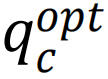 的上限[69]。最优去环是一个NP-hard问题,可以通过置信度传播算法近似求解。已经开发了两种方法:置信度传播引导的化简算法(the belief propagation-guided decimation algorithm) [134]和Min-Sum算法[69] ,尽管复杂度有所增加,它们找到的影响力节点集合比CI算法更小。特别是,这两种算法首先通过消息传递算法对网络进行去环处理,然后使用树破坏器算法(tree-breaker algorithm)分解所得到的森林(即树的不相交组合)。尽管消息传递迭代的计算复杂度与连边数呈线性关系,但参考文献[69]中提出的贪婪树破坏器算法的复杂度O(N(log(N+T)))随T和N数量级缩放,其中T是森林中树的最大直径,N是节点数。此外,Min-Sum算法还包括攻击结束后的重新插入阶段,即一个贪婪过程,重新插入实际上不需要的节点以达到预期目标。这个重插入阶段旨在减少实际从网络中移除的节点数,从而降低攻击成本,适用于胖尾网络,在这些网络中,去环和瓦解问题并不等同。这一阶段报告为亚线性时间复杂度,但确切的复杂性尚未明确[135]。
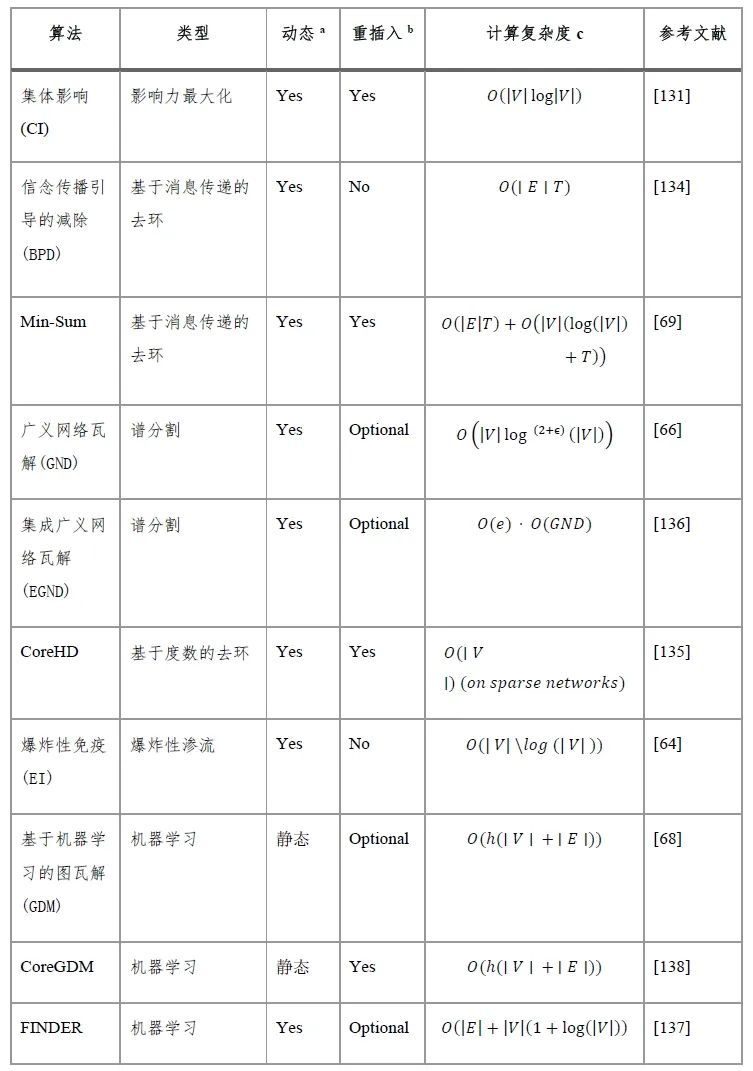
注:V|,节点数量;|E|,边数量;e,集合大小;h,使用的注意力头数量;a 算法是否为动态(或静态);b 算法是否包含重插入节点的阶段;c 报告针对稀疏网络

图2 最新网络瓦解方法的比较。a, 算法在驱动系统——一个拥有309个节点的巴西腐败网络[65]——走向瓦解方面进行了比较,瓦解程度通过最大连通片的相对大小来衡量。b-g, 展示了部分a中不同曲线的瓦解路径。节点的颜色(从深红到白色)代表攻击顺序(灰色节点未被移除),节点的大小代表它们的介数值。攻击后剩余节点的轮廓颜色代表它们所属的簇。部分a改编自参考文献[68], MS+R,即Min-Sum算法加上重插入阶段。
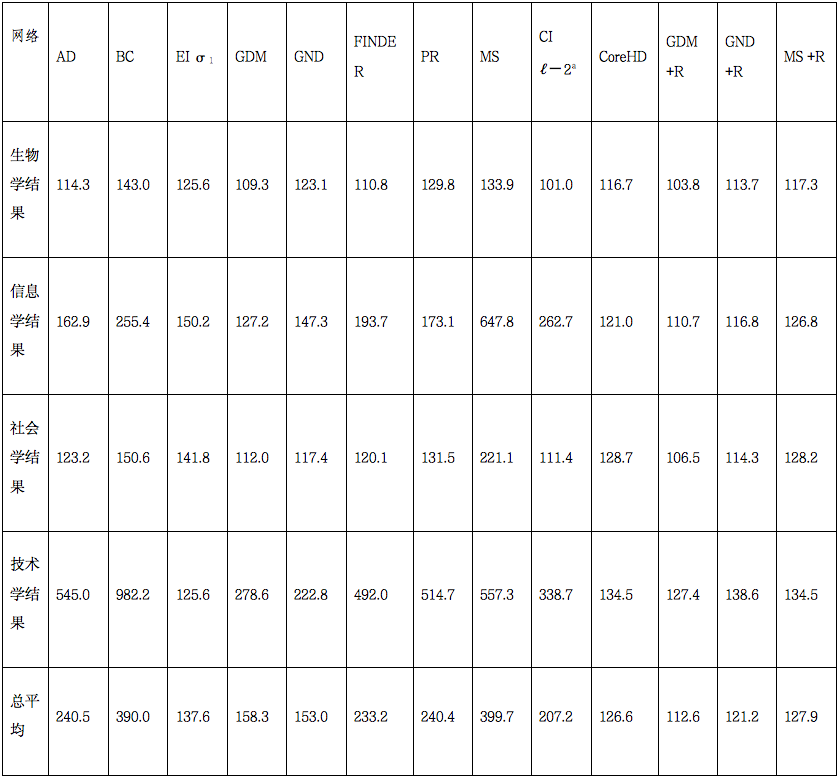
注:每种方法的瓦解目标是网络大小的10%。通过使用辛普森规则对∣LCC(x)∣/∣V∣(最大连通片(LCC)大小作为移除节点的函数)值进行积分计算AUC。为了便于阅读,每个网络的AUC值表示为在该网络上表现最优的方法所得值的百分比,即AUC越低越好。完整结果可在补充表3中查看。AD, 自适应度数;BC, 介数中心性;CI, 集体影响;EI, 爆炸性免疫;GDM, 基于机器学习的图解体;GND, 广义网络瓦解;MS, 最小和;PR, PageRank;+R, 执行了重插入阶段。a CI和CoreHD与其他+R算法进行了比较,因为它们包含了重插入阶段。
五、级联失效
五、级联失效
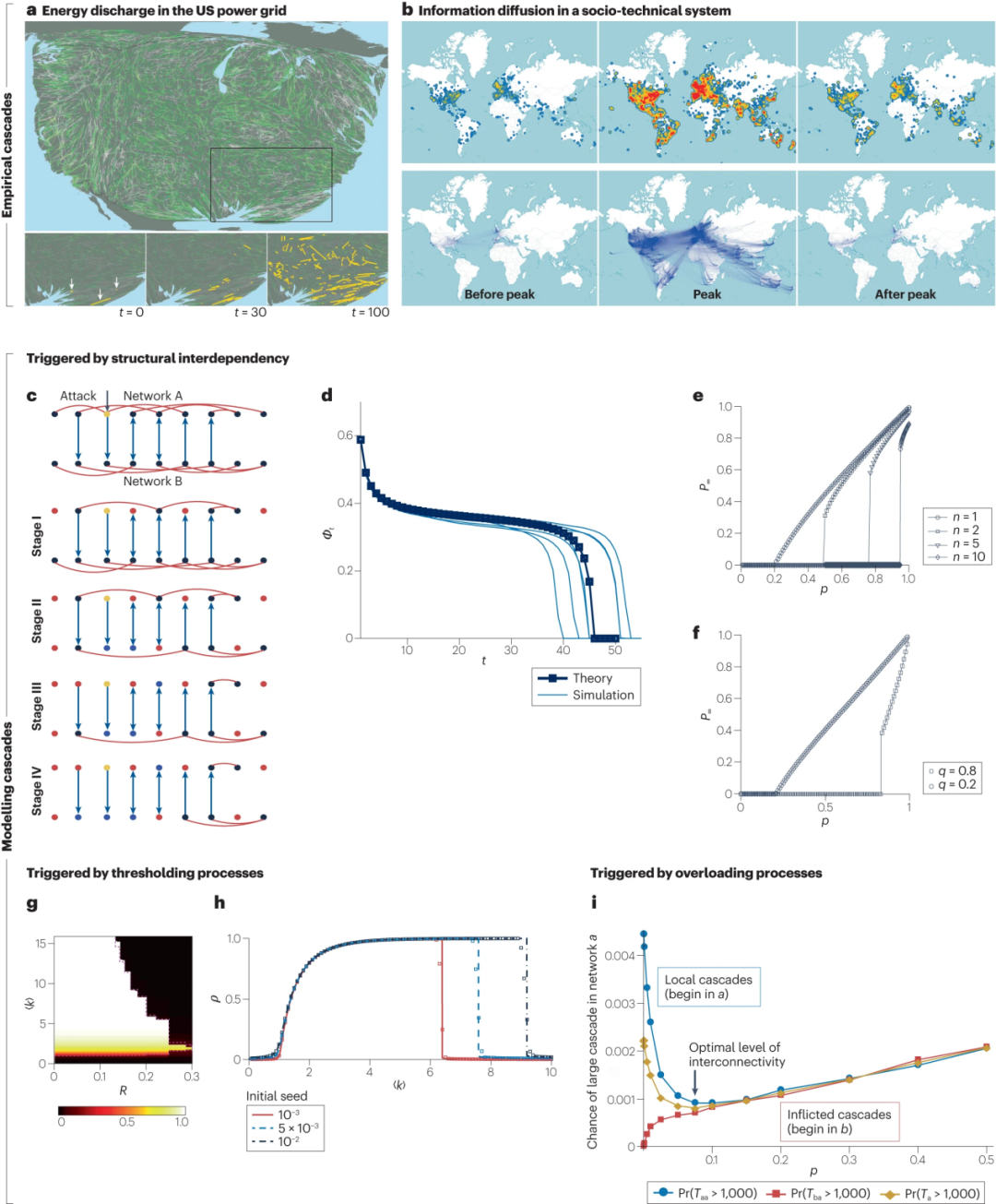
图3 网络失效的演化。a, 在美国-加拿大南部电网的级联传播模拟后的电力线路状态图:未经历停电的线路(绿色)和受影响的电力线路(灰色)。下排:级联由三个故障触发后,受损线路(黄色)演化快照,重缩放时间为t = 0。b, 推特上的信息级联。在诺贝尔奖公告前、期间和之后,有关希格斯玻色子发现的推文密度(上排),以及相应的信息重分享网络(下排)。c, 由相互依赖关系支撑的模型系统中两层耦合网络的故障演变。垂直箭头代表依赖关系。节点颜色表示功能节点(黑色)、最初故障的节点(黄色),以及因不属于最大簇(红色)或依赖于另一个网络中故障节点的单元(蓝色)而被移除。d, 最大连通片的大小(Φt)作为级联步骤(t)的函数。浅蓝线对应于动力学的个体实现,标记表示它们的平均值。深蓝线为理论预测。e,f, 最大连通片的静止大小(P∞)作为最初移除节点比例(p)的函数。实线显示理论预测。n是耦合层的数量;q是双层网络中相互依赖节点的比例。g, 阈值模型中级联停止时的最大连通片,作为阈值R和底层Erdős–Rényi网络的平均度〈k〉的函数。虚线指出级联出现的分析预测。h, 对于固定R = 0.18,级联停止时的最大连通片(ρ)随平均度〈k〉的函数。i, 在两个网络之间的非平凡中间互联水平p(金色曲线,菱形符号)可以缓解大规模负荷削减级联。然而,过多或过少的互连会引发更大的级联,并对鲁棒性产生不利影响。Taa(Tba) 表示在网络a中展开的级联大小,用于在网络a(b)开始的级联。Ta是不区分级联开始位置的网络a中的级联大小。网络a和b各有2,000个节点。部分a经授权转载自参考文献58。部分b改编自参考文献226,。部分c改编自参考文献19。部分d-f转载自参考文献19。部分g,h经授权改编自参考文献171。部分i经授权改编自参考文献190。
 ,可以通过求解以下方程组得到
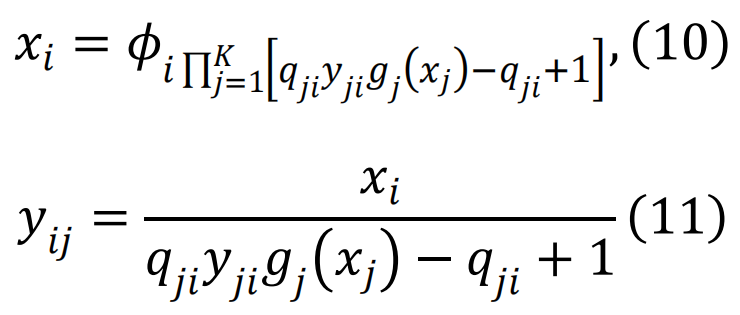
 ,fi(Z)=Hi(Zfi(Z)+1-Z)。
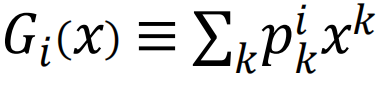 是子系统i的度生成函数,
 是子系统i的剩余度生成函数,该子系统具有度分布
 。K是通过依赖关系连接到i的层的数量[158]。也可以对由连边故障驱动的级联进行分析处理,但与节点故障传播机制相比研究的较少。
六、防止和应对网络崩溃
六、防止和应对网络崩溃
 是一个映射,给出了损害d∈D之后的新网络,则损害d的重要性由性能的相对下降
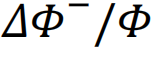 给出,其中
给出,其中
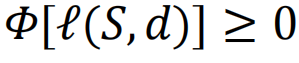 。此外,定义临界损害d*∈D为最小化的损害。然后可以将G因D而产生的脆弱性V定义为[205]。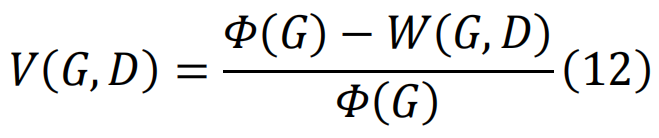
 是网络G在损害类别D下的最差性能。同样,我们可以通过映射
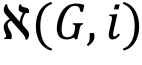 定义一组改进i∈I,对网络G进行改进,以此实现在临界改进i*条件下网络的最优可提升性。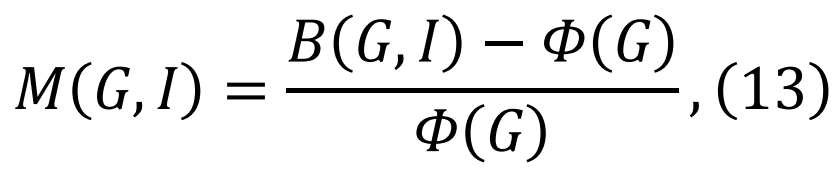
 是在改进类别I下,网络G的最优性能。关于改进i,其重要性由性能相对增加
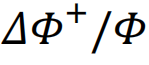 给出,其中
给出,其中 [205]。然而,对于可优化的内容存在一个基本限制:实际上,网络的鲁棒性和其表现是难以同时最大化的竞争特征[223]。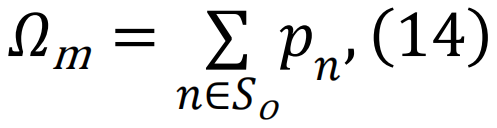

 ,这里的主要思想是,
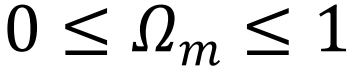 用于量化网络在崩溃前能够容忍的损害程度。当网络的关键节点被移除时,Ω 快速接近 1 [68](见图 4)。
图4:防止和应对网络崩溃。a, 使用基于度的策略反复攻击三种不同网络基础设施(上排)时,通过Ω测量的早期预警信号,最大连通片(LCC)和第二大连通分片(SLCC)的大小(下排),以及通过机器学习图瓦解(GDM)模型测度移除对系统完整性的重要性(PI)。b–d, 一个动态网络标记(DNM)[227],它与老鼠肺组织分子网络中基因表达的波动强度(节点颜色)相关,在8小时处存在临界转变(b部分);DNM已用于捕捉其他系统的早期预警信号,如富营养化湖泊状态(c部分)和美元和欧元货币的利率互换日价格(d部分)。e,f, 规则网络(度连接k = 10,活动点数m = 4,网络规模N = 100)随时间在两种集体模式之间转换的活动节点比例z(上)和系统标记的状态在相图中从t = 0到第一次转变时刻的轨迹(下)。g,h, 一个具有两个网络的系统的最优修复策略,该系统以内部失效节点的比例 和
和 为特征。给定一个崩溃系统的初始状态Si,修复相当于最小化Si和绿色区域最近边界之间的距离,在这个区域系统恢复到完全功能状态。箭头表示遵循的轨迹,而R1和R2是三重点。底部展示了两个合成(左)和实证(右)耦合网络的标记编号所示的集体状态。i–k, 重组和重燃:一个两步程序,将一个受干扰的酵母蛋白质相互作用网络从崩溃阶段(红色)驱动到可恢复阶段(蓝色)。图a转载自参考文献68,图b–d转载自参考文献227图e,f转载自参考文献218,图g,h转载自参考文献215,图i–k转载自参考文献217, EUR代表欧洲;L.A.代表洛杉矶;PCC代表皮尔逊相关系数;SD代表标准偏差。
七、展望
七、展望
参考文献
-
Albert, R. & Barabási, A.-L. Statistical mechanics of complex networks. Rev. Mod. Phys.74, 47 (2002). -
Newman, M. E. The structure and function of complex networks. SIAM Rev.45, 167–256 (2003). -
Boccaletti, S., Latora, V., Moreno, Y., Chavez, M. & Hwang, D.-U. Complex networks: structure and dynamics. Phys. Rep.424, 175–308 (2006). -
Barabási, A.-L. & Albert, R. Emergence of scaling in random networks. Science286, 509–512 (1999). -
Broido, A. D. & Clauset, A. Scale-free networks are rare. Nat. Commun.10, 1017 (2019). -
Gerlach, M. & Altmann, E. G. Testing statistical laws in complex systems. Phys. Rev. Lett.122, 168301 (2019). -
Voitalov, I., van der Hoorn, P., van der Hofstad, R. & Krioukov, D. Scale-free networks well done. Phys. Rev. Res.1, 033034 (2019). -
Serafino, M. et al. True scale-free networks hidden by finite size effects. Proc. Natl Acad. Sci. USA118, e2013825118 (2021). -
Guimera, R. & Nunes Amaral, L. A. Functional cartography of complex metabolic networks. Nature433, 895–900 (2005). -
Newman, M. E. Communities, modules and large-scale structure in networks. Nat. Phys.8, 25–31 (2012). -
Fortunato, S. & Hric, D. Community detection in networks: a user guide. Phys. Rep.659, 1–44 (2016). -
Peixoto, T. P. & Rosvall, M. Modelling sequences and temporal networks with dynamic community structures. Nat. Commun.8, 582 (2017). -
Fortunato, S. & Newman, M. E. 20 years of network community detection. Nat. Phys.18, 848–850 (2022). -
Ravasz, E. & Barabási, A.-L. Hierarchical organization in complex networks. Phys. Rev. E67, 026112 (2003). -
Clauset, A., Moore, C. & Newman, M. E. Hierarchical structure and the prediction of missing links in networks. Nature453, 98–101 (2008). -
Peixoto, T. P. Hierarchical block structures and high-resolution model selection in large networks. Phys. Rev. X4, 011047 (2014). -
Buldyrev, S. V., Parshani, R., Paul, G., Stanley, H. E. & Havlin, S. Catastrophic cascade of failures in interdependent networks. Nature464, 1025–1028 (2010). -
Mucha, P. J., Richardson, T., Macon, K., Porter, M. A. & Onnela, J.-P. Community structure in time-dependent, multiscale, and multiplex networks. Science328, 876–878 (2010). -
Gao, J., Buldyrev, S. V., Stanley, H. E. & Havlin, S. Networks formed from interdependent networks. Nat. Phys.8, 40–48 (2012). -
De Domenico, M. et al. Mathematical formulation of multilayer networks. Phys. Rev. X3, 041022 (2013). -
Artime, O. et al. Multilayer Network Science: From Cells to Societies. Elements in Structure and Dynamics of Complex Networks (Cambridge Univ. Press, 2022). -
Domenico, M. D. More is different in real-world multilayer networks. Nat. Phys.19, 1247–1262 (2023). -
Lambiotte, R., Rosvall, M. & Scholtes, I. From networks to optimal higher-order models of complex systems. Nat. Phys.15, 313–320 (2019). -
Battiston, F. et al. The physics of higher-order interactions in complex systems. Nat. Phys.17, 1093–1098 (2021). -
Bianconi, G. Higher Order Networks: an Introduction to Simplicial Complexes (Cambridge Univ. Press, 2021). -
De Domenico, M. Diffusion geometry unravels the emergence of functional clusters in collective phenomena. Phys. Rev. Lett.118, 168301 (2017). -
García-Pérez, G., Boguñá, M. & Serrano, M. Multiscale unfolding of real networks by geometric renormalization. Nat. Phys.14, 583–589 (2018). -
Boguna, M. et al. Network geometry. Nat. Rev. Phys.3, 114–135 (2021). -
Albert, R., Jeong, H. & Barabási, A.-L. Error and attack tolerance of complex networks. Nature406, 378–382 (2000). -
Motter, A. E. & Lai, Y.-C. Cascade-based attacks on complex networks. Phys. Rev. E66, 065102 (2002). -
Motter, A. E. Cascade control and defense in complex networks. Phys. Rev. Lett.93, 098701 (2004). -
Dorogovtsev, S. N., Goltsev, A. V. & Mendes, J. F. Critical phenomena in complex networks. Rev. Mod. Phys.80, 1275 (2008). -
Liu, X. et al. Network resilience. Phys. Rep.971, 1–108 (2022). -
Bashan, A., Berezin, Y., Buldyrev, S. V. & Havlin, S. The extreme vulnerability of interdependent spatially embedded networks. Nat. Phys.9, 667–672 (2013). -
Zhao, J., Li, D., Sanhedrai, H., Cohen, R. & Havlin, S. Spatio-temporal propagation of cascading overload failures in spatially embedded networks. Nat. Commun.7, 10094 (2016). -
Radicchi, F. & Bianconi, G. Redundant interdependencies boost the robustness of multiplex networks. Phys. Rev. X7, 011013 (2017). -
Arenas, A., Díaz-Guilera, A., Kurths, J., Moreno, Y. & Zhou, C. Synchronization in complex networks. Phys. Rep.469, 93–153 (2008). -
Pastor-Satorras, R., Castellano, C., Van Mieghem, P. & Vespignani, A. Epidemic processes in complex networks. Rev. Mod. Phys.87, 925 (2015). -
De Domenico, M., Granell, C., Porter, M. A. & Arenas, A. The physics of spreading processes in multilayer networks. Nat. Phys.12, 901–906 (2016). -
O’Keeffe, K. P., Hong, H. & Strogatz, S. H. Oscillators that sync and swarm. Nat. Commun.8, 1–13 (2017). -
Scheffer, M. et al. Anticipating critical transitions. Science338, 344–348 (2012). -
Smart, A. G., Amaral, L. A. & Ottino, J. M. Cascading failure and robustness in metabolic networks. Proc. Natl Acad. Sci. USA105, 13223–13228 (2008). -
Barabási, A.-L., Gulbahce, N. & Loscalzo, J. Network medicine: a network-based approach to human disease. Nat. Rev. Genet.12, 56–68 (2011). -
Zitnik, M., Sosič, R., Feldman, M. W. & Leskovec, J. Evolution of resilience in protein interactomes across the tree of life. Proc. Natl Acad. Sci. USA116, 4426–4433 (2019). -
Bullmore, E. & Sporns, O. Complex brain networks: graph theoretical analysis of structural and functional systems. Nat. Rev. Neurosci.10, 186–198 (2009). -
Siegel, J. S. et al. Disruptions of network connectivity predict impairment in multiple behavioral domains after stroke. Proc. Natl Acad. Sci. USA113, E4367–E4376 (2016). -
May, R. M. Will a large complex system be stable? Nature238, 413–414 (1972). -
Holling, C. S. Resilience and stability of ecological systems. Ann. Rev. Ecol. Syst. 1–23 (1973). -
Pimm, S. L. The complexity and stability of ecosystems. Nature307, 321–326 (1984). -
Pocock, M. J., Evans, D. M. & Memmott, J. The robustness and restoration of a network of ecological networks. Science335, 973–977 (2012). -
Bascompte, J. & Stouffer, D. B. The assembly and disassembly of ecological networks. Philos. Trans. R. Soc. Lond. B Biol. Sci.364, 1781–1787 (2009). -
Baggio, J. A. et al. Multiplex social ecological network analysis reveals how social changes affect community robustness more than resource depletion. Proc. Natl Acad. Sci. USA113, 13708–13713 (2016). -
Gai, P. & Kapadia, S. Contagion in financial networks. Proc. R. Soc. A Math. Phys. Eng. Sci.466, 2401–2423 (2010). -
Cimini, G., Squartini, T., Garlaschelli, D. & Gabrielli, A. Systemic risk analysis on reconstructed economic and financial networks. Sci. Rep.5, 15758 (2015). -
Bardoscia, M. et al. The physics of financial networks. Nat. Rev. Phys.3, 490–507 (2021). -
Grassia, M., Mangioni, G., Schiavo, S. & Traverso, S. Insights into countries’ exposure and vulnerability to food trade shocks from network-based simulations. Sci. Rep.12, 4644 (2022). -
Carreras, B. A., Lynch, V. E., Dobson, I. & Newman, D. E. Critical points and transitions in an electric power transmission model for cascading failure blackouts. Chaos12, 985–994 (2002). -
Yang, Y., Nishikawa, T. & Motter, A. E. Small vulnerable sets determine large network cascades in power grids. Science358, eaan3184 (2017). -
Crucitti, P., Latora, V., Marchiori, M. & Rapisarda, A. Efficiency of scale-free networks: error and attack tolerance. Phys. A Stat. Mech. Appl.320, 622–642 (2003). -
Bertagnolli, G., Gallotti, R. & De Domenico, M. Quantifying efficient information exchange in real network flows. Commun. Phys.4, 125 (2021). -
Doyle, J. C. et al. The “robust yet fragile” nature of the internet. Proc. Natl Acad. Sci. USA102, 14497–14502 (2005). -
De Domenico, M. & Arenas, A. Modeling structure and resilience of the dark network. Phys. Rev. E95, 022313 (2017). -
Scott, D. M., Novak, D. C., Aultman-Hall, L. & Guo, F. Network robustness index: a new method for identifying critical links and evaluating the performance of transportation networks. J. Transp. Geogr.14, 215–227 (2006). -
Clusella, P., Grassberger, P., Pérez-Reche, F. J. & Politi, A. Immunization and targeted destruction of networks using explosive percolation. Phys. Rev. Lett.117, 208301 (2016). -
Ribeiro, H. V., Alves, L. G. A., Martins, A. F., Lenzi, E. K. & Perc, M. The dynamical structure of political corruption networks. J. Complex Netw.6, 989–1003 (2018). -
Ren, X.-L., Gleinig, N., Helbing, D. & Antulov-Fantulin, N. Generalized network dismantling. Proc. Natl Acad. Sci. USA116, 6554–6559 (2019). -
Matke, C., Medjroubi, W. & Kleinhans, D. SciGRID — an open source reference model for the European Transmission Network (v0.2). http://www.scigrid.de (2016). -
Grassia, M., De Domenico, M. & Mangioni, G. Machine learning dismantling and early-warning signals of disintegration in complex systems. Nat. Commun.12, 5190 (2021). -
Braunstein, A., Dall’Asta, L., Semerjian, G. & Zdeborová, L. Network dismantling. Proc. Natl Acad. Sci. USA113, 12368–12373 (2016). -
Schneider, C. M., Moreira, A. A., Andrade, J. S., Havlin, S. & Herrmann, H. J. Mitigation of malicious attacks on networks. Proc. Natl Acad. Sci. USA108, 3838–3841 (2011). -
Kinney, R., Crucitti, P., Albert, R. & Latora, V. Modeling cascading failures in the North American power grid. Eur. Phys. J. B46, 101–107 (2005). -
Alves, L. G. et al. The nested structural organization of the worldwide trade multi-layer network. Sci. Rep.9, 2866 (2019). -
Cohen, R., Erez, K., Ben-Avraham, D. & Havlin, S. Breakdown of the internet under intentional attack. Phys. Rev. Lett.86, 3682 (2001). -
Cormen, T., Leiserson, C., Rivest, R. & Stein, C. Introduction to Algorithms 4th edn (MIT Press, 2022). -
Flory, P. J. Molecular size distribution in three dimensional polymers. I. Gelation. J. Am. Chem. Soc.63, 3083–3090 (1941). -
Stauffer, D. & Aharony, A. Introduction to Percolation Theory (CRC, 2018). -
Broadbent, S. R. & Hammersley, J. M. Percolation processes: I. crystals and mazes. Math. Proc. Camb. Philos. Soc.53, 629–641 (1957). -
Isichenko, M. B. Percolation, statistical topography, and transport in random media. Rev. Mod. Phys.64, 961 (1992). -
Sahimi, M. Applications of Percolation Theory (CRC, 1994). -
Araújo, N., Grassberger, P., Kahng, B., Schrenk, K. & Ziff, R. M. Recent advances and open challenges in percolation. Eur. Phys. J. Spec. Top.223, 2307–2321 (2014). -
Rodrigues, F. A. in Network Centrality: an Introduction 177–196 (Springer, 2019). -
Holme, P., Kim, B. J., Yoon, C. N. & Han, S. K. Attack vulnerability of complex networks. Phys. Rev. E65, 056109 (2002). -
Artime, O. & De Domenico, M. Percolation on feature-enriched interconnected systems. Nat. Commun.12, 2478 (2021). -
Molloy, M. & Reed, B. A critical point for random graphs with a given degree sequence. Random Struct. Algor.6, 161–180 (1995). -
Cohen, R., Ben-Avraham, D. & Havlin, S. Percolation critical exponents in scale-free networks. Phys. Rev. E66, 036113 (2002). -
Gordon, M. Good’s theory of cascade processes applied to the statistics of polymer distributions. Proc. R. S. Lond. A Math. Phys. Sci.268, 240–256 (1962). -
Newman, M. E., Strogatz, S. H. & Watts, D. J. Random graphs with arbitrary degree distributions and their applications. Phys. Rev. E64, 026118 (2001). -
Callaway, D. S., Newman, M. E., Strogatz, S. H. & Watts, D. J. Network robustness and fragility: percolation on random graphs. Phys. Rev. Lett.85, 5468 (2000). -
Gross, T. & Barth, L. Network robustness revisited. Front. Phys.10, 823564 (2022). -
Moore, C. & Newman, M. E. Exact solution of site and bond percolation on small-world networks. Phys. Rev. E62, 7059 (2000). -
Goltsev, A. V., Dorogovtsev, S. N. & Mendes, J. F. Percolation on correlated networks. Phys. Rev. E78, 051105 (2008). -
Newman, M. Networks (Oxford Univ. Press, 2018). -
Li, M. et al. Percolation on complex networks: theory and application. Phys. Rep.907, 1–68 (2021). -
Radicchi, F. & Castellano, C. Breaking of the site-bond percolation universality in networks. Nat. Commun.6, 10196 (2015). -
Shiraki, Y. & Kabashima, Y. Cavity analysis on the robustness of random networks against targeted attacks: influences of degree-degree correlations. Phys. Rev. E82, 036101 (2010). -
Barrat, A., Barthelemy, M., Pastor-Satorras, R. & Vespignani, A. The architecture of complex weighted networks. Proc. Natl Acad. Sci. USA101, 3747–3752 (2004). -
Hamilton, K. E. & Pryadko, L. P. Tight lower bound for percolation threshold on an infinite graph. Phys. Rev. Lett.113, 208701 (2014). -
Karrer, B., Newman, M. E. & Zdeborová, L. Percolation on sparse networks. Phys. Rev. Lett.113, 208702 (2014). -
Radicchi, F. Percolation in real interdependent networks. Nat. Phys.11, 597–602 (2015). -
Newman, M. Message passing methods on complex networks. Proc. R. Soc. A479, 20220774 (2023). -
Radicchi, F. Predicting percolation thresholds in networks. Phys. Rev. E91, 010801 (2015). -
Radicchi, F. & Castellano, C. Beyond the locally treelike approximation for percolation on real networks. Phys. Rev. E93, 030302 (2016). -
Newman, M. E. Assortative mixing in networks. Phys. Rev. Lett.89, 208701 (2002). -
Newman, M. E. Mixing patterns in networks. Phys. Rev. E67, 026126 (2003). -
Serrano, M. Á. & Boguná, M. Percolation and epidemic thresholds in clustered networks. Phys. Rev. Lett.97, 088701 (2006). -
Serrano, M. Á. & Boguná, M. Clustering in complex networks. II. Percolation properties. Phys. Rev. E74, 056115 (2006). -
Berchenko, Y., Artzy-Randrup, Y., Teicher, M. & Stone, L. Emergence and size of the giant component in clustered random graphs with a given degree distribution. Phys. Rev. Lett.102, 138701 (2009). -
Newman, M. E. Random graphs with clustering. Phys. Rev. Lett.103, 058701 (2009). -
Rombach, M. P., Porter, M. A., Fowler, J. H. & Mucha, P. J. Core-periphery structure in networks. SIAM J. Appl. Math.74, 167–190 (2014). -
Colomer-de Simón, P. & Boguñá, M. Double percolation phase transition in clustered complex networks. Phys. Rev. X4, 041020 (2014). -
Allard, A., Althouse, B. M., Scarpino, S. V. & Hébert-Dufresne, L. Asymmetric percolation drives a double transition in sexual contact networks. Proc. Natl Acad. Sci. USA114, 8969–8973 (2017). -
Hébert-Dufresne, L. & Allard, A. Smeared phase transitions in percolation on real complex networks. Phys. Rev. Res.1, 013009 (2019). -
Derényi, I., Palla, G. & Vicsek, T. Clique percolation in random networks. Phys. Rev. Lett.94, 160202 (2005). -
Claessens, S., Dell’Ariccia, G., Igan, D. & Laeven, L. Cross-country experiences and policy implications from the global financial crisis. Econ. Policy25, 267–293 (2010). -
Fernandes, N. Economic Effects of Coronavirus Outbreak (COVID-19) on the World Economy IESE Business School Working Paper No. WP-1240-E (ECGI 2020). -
Dorogovtsev, S. N., Goltsev, A. V. & Mendes, J. F. F. k-core organization of complex networks. Phys. Rev. Lett.96, 040601 (2006). -
Baxter, G. J., Dorogovtsev, S. N., Goltsev, A. V. & Mendes, J. F. Bootstrap percolation on complex networks. Phys. Rev. E82, 011103 (2010). -
Bohman, T. & Frieze, A. Avoiding a giant component. Random Struct. Algor.19, 75–85 (2001). -
Spencer, J. & Wormald, N. Birth control for giants. Combinatorica27, 587–628 (2007). -
Beveridge, A., Bohman, T., Frieze, A. & Pikhurko, O. Product rule wins a competitive game. Proc. Am. Math. Soc.135, 3061–3071 (2007). -
Krivelevich, M., Lubetzky, E. & Sudakov, B. Hamiltonicity thresholds in Achlioptas processes. Random Struct. Algor.37, 1–24 (2010). -
Achlioptas, D., D’Souza, R. M. & Spencer, J. Explosive percolation in random networks. Science323, 1453–1455 (2009). -
Riordan, O. & Warnke, L. Explosive percolation is continuous. Science333, 322–324 (2011). -
da Costa, R. A., Dorogovtsev, S. N., Goltsev, A. V. & Mendes, J. F. F. Explosive percolation transition is actually continuous. Phys. Rev. Lett.105, 255701 (2010). -
Grassberger, P., Christensen, C., Bizhani, G., Son, S.-W. & Paczuski, M. Explosive percolation is continuous, but with unusual finite size behavior. Phys. Rev. Lett.106, 225701 (2011). -
D’Souza, R. M., Gómez-Gardenes, J., Nagler, J. & Arenas, A. Explosive phenomena in complex networks. Adv. Phys.68, 123–223 (2019). -
Son, S.-W., Bizhani, G., Christensen, C., Grassberger, P. & Paczuski, M. Percolation theory on interdependent networks based on epidemic spreading. EPL(Europhys. Lett.)97, 16006 (2012). -
Morone, F. & Makse, H. A. Influence maximization in complex networks through optimal percolation. Nature524, 65–68 (2015). -
Granovetter, M. S. The strength of weak ties. Am. J. Sociol.78, 1360–1380 (1973). -
Kempe, D., Kleinberg, J. & Tardos, É. Maximizing the spread of influence through a social network. In Proc. 9th ACM SIGKDD International Conference on Knowledge Discovery and Data Mining 137–146 (ACM, 2003). -
Morone, F., Min, B., Bo, L., Mari, R. & Makse, H. Collective influence algorithm to find influencers via optimal percolation in massively large social media. Sci. Rep.6, 30062 (2016). -
Altarelli, F., Braunstein, A., Dall’Asta, L., Wakeling, J. R. & Zecchina, R. Containing epidemic outbreaks by message-passing techniques. Phys. Rev. X4, 021024 (2014). -
Altarelli, F., Braunstein, A., Dall’Asta, L. & Zecchina, R. Optimizing spread dynamics on graphs by message passing. J. Stat. Mech. Theory Exp.2013, 09011 (2013). -
Mugisha, S. & Zhou, H.-J. Identifying optimal targets of network attack by belief propagation. Phys. Rev. E94, 012305 (2016). -
Zdeborová, L., Zhang, P. & Zhou, H.-J. Fast and simple decycling and dismantling of networks. Sci. Rep.https://doi.org/10.1038/srep37954 (2016). -
Ren, X.-L. & Antulov-Fantulin, N. in Complex Networks and Their Applications VIII (eds Cherifi, H. et al.) 783–793 (Springer, 2020). -
Fan, C., Zeng, L., Sun, Y. & Liu, Y.-Y. Finding key players in complex networks through deep reinforcement learning. Nat. Mach. Intell.2, 317–324 (2020). -
Grassia, M. & Mangioni, G. in Complex Networks XIV (eds Teixeira, A. S. et al.) 86–94 (Springer Nature, 2023). -
Osat, S., Papadopoulos, F., Teixeira, A. S. & Radicchi, F. Embedding-aided network dismantling. Phys. Rev. Res.5, 013076 (2023). -
Osat, S., Faqeeh, A. & Radicchi, F. Optimal percolation on multiplex networks. Nat. Commun.8, 1540 (2017). -
Szolnoki, A. & Perc, M. Collective influence in evolutionary social dilemmas. EPL (Europhys. Lett.)113, 58004 (2016). -
Chen, B.-L. et al. Influence blocking maximization on networks: models, methods and applications. Phys. Rep.976, 1–54 (2022). -
Radicchi, F. & Castellano, C. Fundamental difference between superblockers and superspreaders in networks. Phys. Rev. E95, 012318 (2017). -
Makse, H. A. The Science of Influencers and Superspreaders (Springer Nature, 2023). -
De Domenico, M. & Biamonte, J. Spectral entropies as information-theoretic tools for complex network comparison. Phys. Rev. X6, 041062 (2016). -
Ghavasieh, A., Stella, M., Biamonte, J. & De Domenico, M. Unraveling the effects of multiscale network entanglement on empirical systems. Commun. Phys.4, 129 (2021). -
Ghavasieh, A., Bertagnolli, G. & De Domenico, M. Dismantling the information flow in complex interconnected systems. Phys. Rev. Res.5, 013084 (2023). -
Lancichinetti, A., Fortunato, S. & Radicchi, F. Benchmark graphs for testing community detection algorithms. Phys. Rev. E78, 046110 (2008). -
Strogatz, S. et al. Fifty years of ‘More is different’. Nat. Rev. Phys.4, 508–510 (2022). -
Kivelä, M. et al. Multilayer networks. J. Complex Netw.2, 203–271 (2014). -
Boccaletti, S. et al. The structure and dynamics of multilayer networks. Phys. Rep.544, 1–122 (2014). -
Bianconi, G. Multilayer Networks: Structure and Function (Oxford Univ. Press, 2018). -
Kenett, D. Y., Perc, M. & Boccaletti, S. Networks of networks — an introduction. Chaos Solitons Fractals80, 1–6 (2015). -
Gao, J., Bashan, A., Shekhtman, L. & Havlin, S. Introduction to Networks of Networks (IOP, 2022). -
Gao, J., Buldyrev, S. V., Havlin, S. & Stanley, H. E. Robustness of a network of networks. Phys. Rev. Lett.107, 195701 (2011). -
Parshani, R., Buldyrev, S. V. & Havlin, S. Interdependent networks: reducing the coupling strength leads to a change from a first to second order percolation transition. Phys. Rev. Lett.105, 048701 (2010). -
Schneider, C. M., Yazdani, N., Araújo, N. A., Havlin, S. & Herrmann, H. J. Towards designing robust coupled networks. Sci. Rep.3, 1–7 (2013). -
Chen, S., Gao, Y., Liu, X., Gao, J. & Havlin, S. Robustness of interdependent networks based on bond percolation. EPL(Europhys. Lett.)130, 38003 (2020). -
Parshani, R., Rozenblat, C., Ietri, D., Ducruet, C. & Havlin, S. Inter-similarity between coupled networks. EPL(Europhys. Lett.)92, 68002 (2011). -
Buldyrev, S. V., Shere, N. W. & Cwilich, G. A. Interdependent networks with identical degrees of mutually dependent nodes. Phys. Rev. E83, 016112 (2011). -
Reis, S. D. et al. Avoiding catastrophic failure in correlated networks of networks. Nat. Phys.10, 762–767 (2014). -
Shekhtman, L. M., Danziger, M. M. & Havlin, S. Recent advances on failure and recovery in networks of networks. Chaos Solitons Fractals90, 28–36 (2016). -
Valdez, L. D. et al. Cascading failures in complex networks. J. Complex Netw.8, cnaa013 (2020). -
Schelling, T. C. Hockey helmets, concealed weapons, and daylight saving: a study of binary choices with externalities. J. Confl. Resolut.17, 381–428 (1973). -
Granovetter, M. Threshold models of collective behavior. Am. J. Sociol.83, 1420–1443 (1978). -
Easley, D. & Kleinberg, J. Networks, Crowds, and Markets: Reasoning About a Highly Connected World (Cambridge Univ. Press, 2010). -
Gallotti, R., Valle, F., Castaldo, N., Sacco, P. & De Domenico, M. Assessing the risks of ‘infodemics’ in response to COVID-19 epidemics. Nat. Hum. Behav.4, 1285–1293 (2020). -
Watts, D. J., Rothschild, D. M. & Mobius, M. Measuring the news and its impact on democracy. Proc. Natl Acad. Sci. USA118, e1912443118 (2021). -
Valente, T. W. Network models and methods for studying the diffusion of innovations. Model Methods Soc. Netw. Anal.28, 98–116 (2005). -
Watts, D. J. A simple model of global cascades on random networks. Proc. Natl Acad. Sci. USA99, 5766–5771 (2002). -
Gleeson, J. P. & Cahalane, D. J. Seed size strongly affects cascades on random networks. Phys. Rev. E75, 056103 (2007). -
Liu, R.-R., Wang, W.-X., Lai, Y.-C. & Wang, B.-H. Cascading dynamics on random networks: crossover in phase transition. Phys. Rev. E85, 026110 (2012). -
Centola, D., Eguíluz, V. M. & Macy, M. W. Cascade dynamics of complex propagation. Phys. A Stat. Mech. Appl.374, 449–456 (2007). -
Gleeson, J. P. Cascades on correlated and modular random networks. Phys. Rev. E77, 046117 (2008). -
Dodds, P. S. & Payne, J. L. Analysis of a threshold model of social contagion on degree-correlated networks. Phys. Rev. E79, 066115 (2009). -
Hackett, A., Melnik, S. & Gleeson, J. P. Cascades on a class of clustered random networks. Phys. Rev. E83, 056107 (2011). -
Snyder, J., Cai, W. & D’Souza, R. M. Degree-targeted cascades in modular, degree-heterogeneous networks. Phys. Rev. Res.4, 013040 (2022). -
Karimi, F. & Holme, P. Threshold model of cascades in empirical temporal networks. Phys. A Stat. Mech. Appl.392, 3476–3483 (2013). -
Backlund, V.-P., Saramäki, J. & Pan, R. K. Effects of temporal correlations on cascades: threshold models on temporal networks. Phys. Rev. E89, 062815 (2014). -
Brummitt, C. D., Lee, K.-M. & Goh, K.-I. Multiplexity-facilitated cascades in networks. Phys. Rev. E85, 045102 (2012). -
Yu, Y. et al. System crash as dynamics of complex networks. Proc. Natl Acad. Sci. USA113, 11726–11731 (2016). -
Galstyan, A. & Cohen, P. Cascading dynamics in modular networks. Phys. Rev. E75, 036109 (2007). -
Dodds, P. S. & Watts, D. J. Universal behavior in a generalized model of contagion. Phys. Rev. Lett.92, 218701 (2004). -
Bak, P., Tang, C. & Wiesenfeld, K. Self-organized criticality: an explanation of the 1/f noise. Phys. Rev. Lett.59, 381 (1987). -
Bak, P., Tang, C. & Wiesenfeld, K. Self-organized criticality. Phys. Rev. A38, 364 (1988). -
Bonabeau, E. Sandpile dynamics on random graphs. J. Phys. Soc. Japan64, 327–328 (1995). -
Lise, S. & Paczuski, M. Nonconservative earthquake model of self-organized criticality on a random graph. Phys. Rev. Lett.88, 228301 (2002). -
Goh, K.-I., Lee, D.-S., Kahng, B. & Kim, D. Sandpile on scale-free networks. Phys. Rev. Lett.91, 148701 (2003). -
Lee, D.-S., Goh, K.-I., Kahng, B. & Kim, D. Sandpile avalanche dynamics on scale-free networks. Phys. A Stat. Mech. Appl.338, 84–91 (2004). -
Brummitt, C. D., D’Souza, R. M. & Leicht, E. A. Suppressing cascades of load in interdependent networks. Proc. Natl Acad. Sci. USA109, E680–E689 (2012). -
Mikaberidze, G. & D’Souza, R. M. Sandpile cascades on oscillator networks: the BTW model meets Kuramoto. Chaos32, 053121 (2022). -
Daqing, L., Yinan, J., Rui, K. & Havlin, S. Spatial correlation analysis of cascading failures: congestions and blackouts. Sci. Rep.4, 5381 (2014). -
Hines, P. D., Dobson, I. & Rezaei, P. Cascading power outages propagate locally in an influence graph that is not the actual grid topology. IEEE Trans. Power Syst.32, 958–967 (2016). -
Schäfer, B., Witthaut, D., Timme, M. & Latora, V. Dynamically induced cascading failures in power grids. Nat. Commun.9, 1975 (2018). -
Valente, A., De Domenico, M. & Artime, O. Non-Markovian random walks characterize network robustness to nonlocal cascades. Phys. Rev. E105, 044126 (2022). -
Barthelemy, M. Betweenness centrality in large complex networks. Eur. Phys. J. B38, 163–168 (2004). -
Kornbluth, Y. et al. Network overload due to massive attacks. Phys. Rev. E97, 052309 (2018). -
Artime, O. & De Domenico, M. Abrupt transition due to non-local cascade propagation in multiplex systems. New J. Phys.22, 093035 (2020). -
Moreno, Y., Pastor-Satorras, R., Vázquez, A. & Vespignani, A. Critical load and congestion instabilities in scale-free networks. EPL(Europhys. Lett.)62, 292 (2003). -
Lai, Y.-C., Motter, A. E. & Nishikawa, T. Attacks and cascades in complex networks. Complex Netw.650, 299–310 (2004). -
Wang, W.-X. & Chen, G. Universal robustness characteristic of weighted networks against cascading failure. Phys. Rev. E77, 026101 (2008). -
Cao, X.-B., Hong, C., Du, W.-B. & Zhang, J. Improving the network robustness against cascading failures by adding links. Chaos Solitons Fractals57, 35–40 (2013). -
Pahwa, S., Scoglio, C. & Scala, A. Abruptness of cascade failures in power grids. Sci. Rep.4, 3694 (2014). -
Paul, G., Tanizawa, T., Havlin, S. & Stanley, H. E. Optimization of robustness of complex networks. Eur. Phys. J. B38, 187–191 (2004). -
Latora, V. & Marchiori, M. Vulnerability and protection of infrastructure networks. Phys. Rev. E71, 015103 (2005). -
Reis, S. D. S. et al. Avoiding catastrophic failure in correlated networks of networks. Nat. Phys.10, 762–767 (2014). -
Carchiolo, V., Grassia, M., Longheu, A., Malgeri, M. & Mangioni, G. Network robustness improvement via long-range links. Comput. Soc. Netw.6, 12 (2019). -
Carchiolo, V., Grassia, M., Longheu, A., Malgeri, M. & Mangioni, G. in Internet and Distributed Computing Systems (eds Xiang, Y. et al.) 270–277 (Springer, 2018). -
Chen, L., Liu, R., Liu, Z.-P., Li, M. & Aihara, K. Detecting early-warning signals for sudden deterioration of complex diseases by dynamical network biomarkers. Sci. Rep.2, 342 (2012). -
Squartini, T., Van Lelyveld, I. & Garlaschelli, D. Early-warning signals of topological collapse in interbank networks. Sci. Rep.3, 3357 (2013). -
Suweis, S. & D’Odorico, P. Early warning signs in social-ecological networks. PLoS ONE9, e101851 (2014). -
Dakos, V. & Bascompte, J. Critical slowing down as early warning for the onset of collapse in mutualistic communities. Proc. Natl Acad. Sci. USA111, 17546–17551 (2014). -
Kuehn, C., Zschaler, G. & Gross, T. Early warning signs for saddle-escape transitions in complex networks. Sci. Rep.5, 13190 (2015). -
Bauch, C. T., Sigdel, R., Pharaon, J. & Anand, M. Early warning signals of regime shifts in coupled human–environment systems. Proc. Natl Acad. Sci. USA113, 14560–14567 (2016). -
Majdandzic, A. et al. Multiple tipping points and optimal repairing in interacting networks. Nat. Commun.7, 10850 (2016). -
Sun, E. D., Michaels, T. C. T. & Mahadevan, L. Optimal control of aging in complex networks. Proc. Natl Acad. Sci. USA117, 20404–20410 (2020). -
Sanhedrai, H. et al. Reviving a failed network through microscopic interventions. Nat. Phys.18, 338–349 (2022). -
Majdandzic, A. et al. Spontaneous recovery in dynamical networks. Nat. Phys.10, 34–38 (2014). -
Lin, Z.-H. et al. Non-Markovian recovery makes complex networks more resilient against large-scale failures. Nat. Commun.11, 2490 (2020). -
Zhou, D. & Elmokashfi, A. Network recovery based on system crash early warning in a cascading failure model. Sci. Rep.8, 7443 (2018). -
Pan, X. & Wang, H. Resilience of and recovery strategies for weighted networks. PLoS ONE13, e0203894 (2018). -
Smith, A. M. et al. Competitive percolation strategies for network recovery. Sci. Rep.9, 11843 (2019). -
Pasqualetti, F., Zhao, S., Favaretto, C. & Zampieri, S. Fragility limits performance in complex networks. Sci. Rep.10, 1774 (2020). -
Di Muro, M. A., La Rocca, C. E., Stanley, H. E., Havlin, S. & Braunstein, L. A. Recovery of interdependent networks. Sci. Rep.6, 1–11 (2016). -
Artime, O., d’Andrea, V., Gallotti, R., Sacco, P. L. & De Domenico, M. Effectiveness of dismantling strategies on moderated vs. unmoderated online social platforms. Sci. Rep.10, 14392 (2020). -
De Domenico, M., Lima, A., Mougel, P. & Musolesi, M. The anatomy of a scientific rumor. Sci. Rep.3, 1–9 (2013). -
Liu, R., Chen, P., Aihara, K. & Chen, L. Identifying early-warning signals of critical transitions with strong noise by dynamical network markers. Sci. Rep.5, 17501 (2015).
(参考文献可上下滑动查看)
复杂网络瓦解读书会
复杂网络瓦解读书会
推荐阅读
7. 重整化群与非线性物理,寻找复杂系统跨尺度的分析方法丨新课发布
微信扫一扫,分享到朋友圈