21世纪的首要悖论:技术进步与社会发展背道而驰
1. 社交媒体推动社会变革?——似是而非的有效传播(Beyond Viral)

From cacm.acm.org April 4, 5:40 PM
By Manuel Cebrian, Iyad Rahwan, Alex “Sandy” Pentland
(Translated by – 秦堉朗,Edited by 傅渥成)
近年来,在解决重大全球性问题上,我们似乎依然力不从心。与此同时,社交媒体的黄金时代正与全球领导力危机一同到来。现阶段,似乎没有人——无论是一个充满魅力的领袖或是一帮籍籍无名的大众——能够让这些全球性问题受到足够多的关注并推动整个社会为之付出行动。由于这种领导力的缺失,各种各样的社会进程也似乎停滞不前。这些现象归根究底是如何在社交媒体——已经成熟发展,广泛应用,并被人们称赞为唤醒社会集体意识、动员社会力量的终极工具——大行其道的时代发生的呢?在此笔者认为,社交媒体技术的发展与“权利的终结”现象共同存在绝非巧合,反而展现了21世纪的首要悖论:技术进步与社会发展的背道而驰。
近年来,由社交媒体主导的社会运动数量占到了一个历史性的高比例,我们见证了这一时代。在诸如阿拉伯之春、占领华尔街运动、乌克兰亲欧示威,以及由于英国骚乱和波士顿马拉松爆炸嫌犯追捕所带来的混乱等社会运动中,社交媒体都在社会运动中起到了举足轻重的作用。现在已经有大量的关注度集中在数字社交媒体平台所扮演的角色上,特别是Facebook和Twitter——这些社会运动的推波助澜者们。容易被获取的数据为人们首次细致入微地观察这些事件的演化过程提供了可能。
通过对这些事件的分析,社会活动家们更加清楚地发现,经由社交媒体来推动大规模的社会运动是难以实现的,就算他们能够掀起一场运动,也很难去维持运动的焦点,直到这个运动能够大面积地影响政治家、政府机构和整个社会。结果,大部分的这类运动都在特定的场景爆发,在一段时间内吸引了我们的眼球,然后就在毫无长久建树的遗憾和人们的淡忘中不了了之。根据我们对社会运动的所有这些了解,为什么社交媒体不能成为通向有建设性的社会变革的桥梁?
原文
The golden age of social media coincides with a worldwide leadership crisis, manifested by our seeming inability to address any major global issue in recent years. These days, no one—be they a charismatic leader or a nameless crowd—seems to be able to make issues popular for long enough to mobilize society into action. As a result of this leadership vacuum, social progress of all sorts seems to have become stymied and frozen. How can this happen precisely in a time when social media, praised as the ultimate tool to raise collective awareness and mobilize society, has reached maturity and widespread use? Here, we argue the coexistence of social media technologies with ‘The End of Power’ is anything but a coincidence, presenting the first techno-social paradox of the 21st century.
In recent years, we have witnessed social media playing a major role in social mobilization events of historic proportions, such as the Arab Spring, the Occupy Wall Street movement, Ukraine’s Euromaidan, and the chaos generated by the England Riots and Boston Marathon bombing manhunt. There has been substantial emphasis on the role of digital social media platforms, particularly Facebook and Twitter, as the facilitators of these mobilizations. Data availability has made it possible, for the first time, to observe the evolution of these events in detail. Analysis of these events makes it clear that political activists find it difficult to use social media to create mass mobilization; and even when they succeed it is difficult to sustain the focus of the protest until it is able to mobilize politicians, institutions, and society at large. As a result, most of these events burst upon the scene, occupy our attention for a few days, and then fade into oblivion with nothing substantial having been accomplished. Given all we have learned about social mobilization, why isn’t social media a more reliable channel for constructive social change?
原文链接:
http://dx.doi.org/10.1145/2818992
2. 多层随机分块模型揭示复杂网络的多层结构(Multilayer Stochastic Block Models Reveal the Multilayer Structure of Complex Networks)
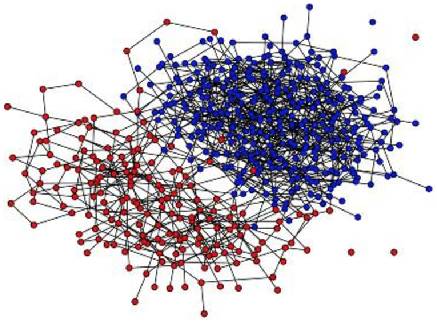
From Phys. Rev. X 6, 011036 – Published 31 March 2016 April 5, 5:46 PM
By Toni Vallès-Català, Francesco A. Massucci, Roger Guimerà, and Marta Sales-Pardo
(Translated by -dan,Edited by 傅渥成)
在复杂系统中,我们观察到的系统各部分之间的相互作用网络实际上是通过不同的机制产生或者发生在不同的层次之间的多种相互作用的聚合。最新的研究表明,多个交互层次的存在能够显著地影响发生在复杂系统上的动态过程。这些研究假设每个层次以内,系统各部分的相互作用是已知的,然而,通常我们并不能得到真实世界里复杂系统上的这些相互作用信息。在本文中,我们为了从聚合的网络数据(即观察到的数据)中发掘出不同的相互作用层次,推广了单层的随机分块模型,引入了多层随机分块模型,把层次聚合的不同机制考虑在内。对给定的观察到的聚合网络数据,我们首先找出最优的多层随机分块模型问题的完全概率解。但由于这个解的计算非常复杂,我们提出一种近似解,能够帮助我们验证:多层随机分块模型能够预测真实世界里的复杂系统的网络结构。
原文:
In complex systems, the network of interactions we observe between systems components is the aggregate of the interactions that occur through different mechanisms or layers. Recent studies reveal that the existence of multiple interaction layers can have a dramatic impact in the dynamical processes occurring on these systems. However, these studies assume that the interactions between systems components in each one of the layers are known, while typically for real-world systems we do not have that information. Here, we address the issue of uncovering the different interaction layers from aggregate data by introducing multilayer stochastic block models (SBMs), a generalization of single-layer SBMs that considers different mechanisms of layer aggregation. First, we find the complete probabilistic solution to the problem of finding the optimal multilayer SBM for a given aggregate-observed network. Because this solution is computationally intractable, we propose an approximation that enables us to verify that multilayer SBMs are more predictive of network structure in real-world complex systems.
原文链接:
http://dx.doi.org/10.1103/PhysRevX.6.011036

复杂文摘翻译小组翻译作品集锦
复杂文摘翻译第2期
大数据如何造成虚假信心
编辑:Dandelion


让苹果砸得更猛烈些吧!

长按识别二维码,关注集智Club,
让我们离科学探索更近一步。
▼点击阅读更多文摘
始发于微信公众号: 集智俱乐部
微信扫一扫,分享到朋友圈