城市空间组织模式与交互(二)|周六直播·复杂系统视角的城市科学读书会
导语
在了解了城市空间组织研究脉络后,我们将继续探讨如何定量刻画城市(及内部要素)的交互模式及其背后的动力学机制。人类移动性在宏观和微观层面有怎样的特征?城市的空间结构与人类移动性有怎样的联系?空间交互又如何与下一个子主题的城市标度律建立联系?
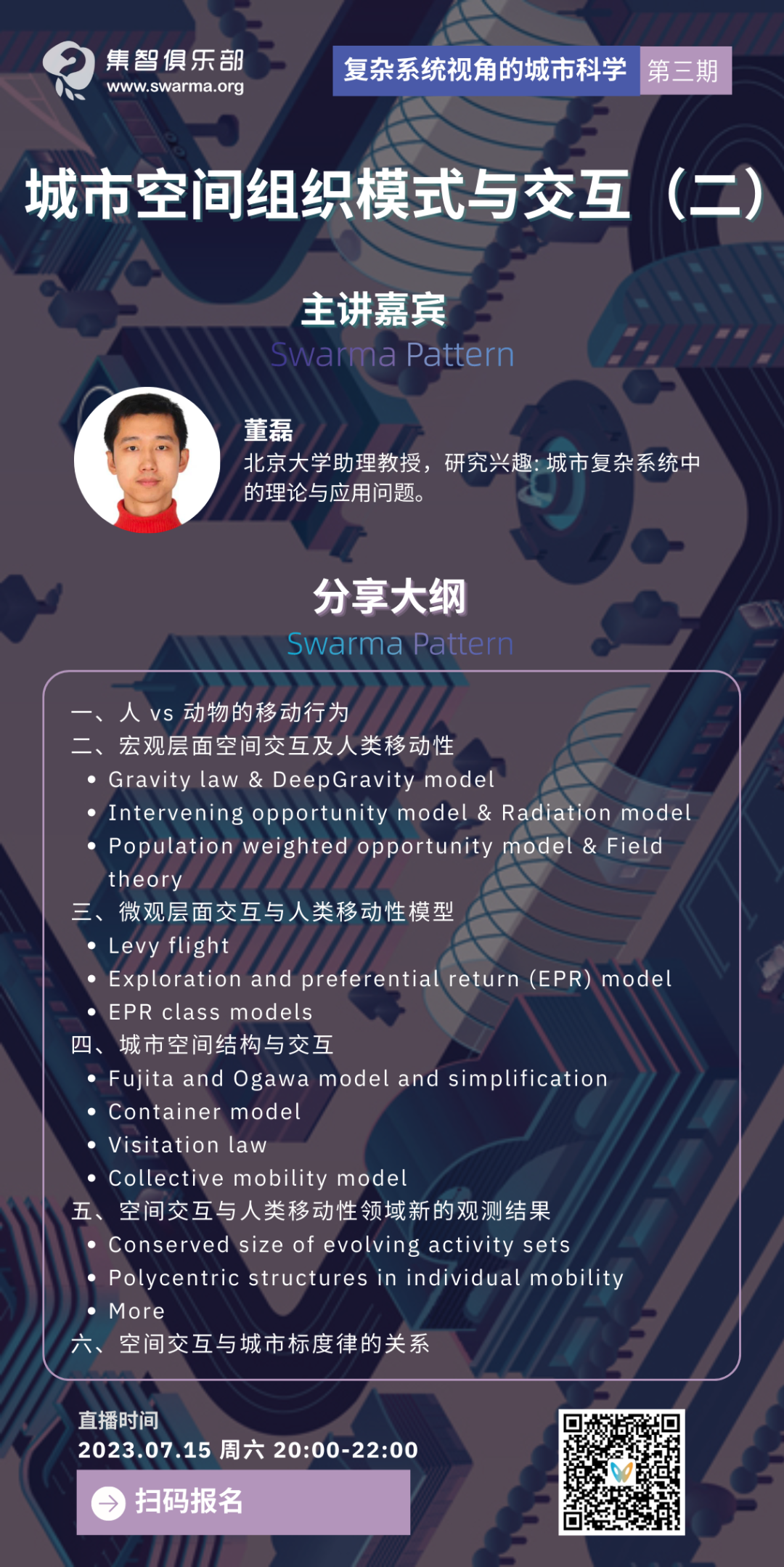
“复杂系统视角下的城市科学”读书会第三次分享,我们邀请到了董磊老师以《空间组织模式与交互(二)》为题,为我们介绍宏微观层面上的空间交互、人类移动性模型,城市空间结构与交互的理论模型和实证研究,以及空间交互与城市标度律的关系。
集智俱乐部的“城市科学”读书会由北京大学助理教授董磊联合明尼苏达大学助理教授朱递、中南大学地球科学与信息物理学院教授李海峰、北京航空航天大学计算机学院博士寄家豪共同发起,通过对“城市作为复杂系统”的理论、研究方法及应用的分享、讨论和梳理,促进相关领域学者的交流,推动交叉学科间的合作,促进城市科学的发展和研究。本系列读书会线上进行,2023年7月1日开始,每周六晚 20:00-22:00,持续时间预计10周。欢迎对城市科学这一前沿领域有兴趣的朋友报名参与!

分享简介
分享简介
本期读书会,董磊老师将重点介绍人类移动性的宏微观模型,以及城市空间结构与城市空间交互、人类移动性的联系。
• 第一部分介绍人和动物的移动行为的相似点和不同。
• 第二部分介绍宏观层面的空间交互以及人类移动性规律。首先回顾经典的空间交互理论,包括重力模型(Gravity law)及延伸出的 DeepGravity model;然后介绍中介机会模型(Intervening opportunity model)和基于中介机会模型发展出的辐射模型(Radiation model);最后介绍人口权重机会模型(Population weighted opportunity model),并从场论(Field theory)角度引入矢量参数来刻画人类移动性特征。
• 第三部分介绍微观层面的交互与人类移动性模型。首先介绍莱维飞行(Lévy flight)及其对个体移动性建模的启发;然后重点介绍探索和偏好返回模型(Exploration and preferential return (EPR) model)及EPR模型的延伸模型,考虑人群、环境异质性对人类出行行为的影响。
• 第四部分介绍城市空间结构与交互的理论模型。包括:Fujita and Ogawa model,一个非单中心城市土地利用模型,并讨论其简化形式;Container model,解释由个体的移动轨迹所形成的城市空间层级结构;Visitation law,揭示了人类移动中的“距离-频率”平方反比法则;最后讨论一些结合群体行为的模型(Collective mobility model)。
• 第五部分介绍空间交互与人类移动性领域新的观测结果。
• 第六部分介绍空间交互与城市标度律的关系。
分享大纲
分享大纲
-
Gravity law & DeepGravity model
-
Intervening opportunity model & Radiation model
-
Population weighted opportunity model & Field theory
-
Levy flight
-
Exploration and preferential return (EPR) model
-
EPR class models
-
Fujita and Ogawa model and simplification
-
Container model
-
Visitation law
-
Collective mobility model
-
Conserved size of evolving activity sets
-
Polycentric structures in individual mobility
-
More
核心概念
核心概念
-
重力模型 Gravity law:在各种社会科学中被用来预测和描述某些行为,这些行为模仿了艾萨克·牛顿引力定律中描述的引力相互作用。一般来说,社会科学模型包含一些质量和距离的元素,这使它们成为物理引力的隐喻,例如城市之间的人口流动。参考社会引力定律——追根溯源 -
深度重力模型 DeepGravity model:一个生成流动概率的有效模型,利用从自发地理数据中提取的许多特征(例如,土地利用、道路网络、交通、食品、卫生设施),并使用深度神经网络来发现这些特征与流动之间的非线性关系。 -
中介机会模型 Intervening opportunity model:最早从个体目的地选择行为角度建立的预测人类移动的模型, 它将起终点之间的介入机会作为影响人类移动的关键因素, 启发研究者提出了许多新的介入机会类模型。 -
辐射模型 Radiation model:模拟人群在区域间迁移的一个模型,它比广泛使用的重力迁移模型提供了更好的经验预测。 -
人口权重机会模型 Population weighted opportunity model:考虑了人口分布及其对机会的影响,用于预测人们在城市中的出行和活动。 -
场论 Field theory:物理学中把某个物理量在空间的一个区域内的分布称为场,如温度场、密度场、引力场、电场、磁场等。当场论被应用到社会科学领域时,它试图描绘行为发生的场的整体性和复杂性。 -
莱维飞行 Lévy flight:一种随机行走,其中步长具有稳定分布,是重尾概率分布。当定义为在大于1的空间中行走时,所做的步骤是在各向同性随机方向上。后扩展了其使用范围,将随机行走发生在离散网格上而不是连续空间上的情况也包括在内。 -
探索和偏好返回模型 Exploration and preferential return (EPR) model:描述了人类移动性,个体会探索新的地区,然后倾向于返回熟悉的地方。它捕捉了个体在移动模式中追求新奇与对熟悉环境的偏好之间的平衡。 -
Fujita and Ogawa model:一个非单中心城市土地利用模型,该模型既不需要事先指定就业地点,也不需要预先指定居住地点。该模型能够产生多中心模式以及单中心和分散模式,并且该模型通常在每个固定的参数值集下产生多个平衡。 -
Container model:解释由个体的移动轨迹所形成的城市空间层级结构。人类的流动是在与熟悉的尺度相一致的分层容器中组织的,并且当不同容器之间的运动组合在一起时,会出现幂律分布。 -
Visitation law:指人类在访问不同地点时呈现出的偏好和行为规律。任何地点的游客数量都会随着他们的访问频率和旅行距离的乘积的平方反比而减少。根据这一法则,人们更倾向于访问距离近、便利和有吸引力的地点,而对于距离较远或不太吸引人的地点则访问频率较低。
主讲人介绍
主讲人介绍

直播信息
直播信息

参考文献
参考文献
综述及展望文章(Perspective)
-
Human mobility: Models and applications, Physics Reports, 2018. https://doi.org/10.1016/j.physrep.2018.01.001
-
人类行为时空特性的统计力学, 电子科技大学学报, 2013. https://doi.org/10.3969/j.issn.1001-0548.2013.04.001
-
大数据时代的空间交互分析方法和应用再论,地理学报,2020. https://doi.org/10.11821/dlxb202007014
-
Future directions in human mobility science, Nature Computational Science, 2023. https://doi.org/10.1038/s43588-023-00469-4
-
A survey of results on mobile phone datasets analysis, EPJ Data Science, 2015. https://doi.org/10.1140/epjds/s13688-015-0046-0
一、人与动物行为对比
-
On the Levy-walk nature of human mobility: Do humans walk like monkeys, IEEE/ACM Transactions on Networking, 2011. https://doi.org/10.1109/INFOCOM.2008.145
二、宏观层面空间交互及人类移动性
-
The laws of migration, Journal of the Statistical Society, 1885. https://doi.org/10.2307/2979181
-
A universal model for mobility and migration patterns, Nature, 2012. https://doi.org/10.1038/nature10856
-
Universal predictability of mobility patterns in cities, Interface, 2014. https://doi.org/10.1098/rsif.2014.0834
-
Field theory for recurrent mobility, Nature Comm, 2019. https://doi.org/10.1038/s41467-019-11841-2
三、微观层面交互与人类移动性模型
-
The scaling laws of human travel, Nature, 2006. https://doi.org/10.1038/nature04292
-
Understanding individual human mobility patterns, Nature, 2008. https://doi.org/10.1038/nature06958
-
Modelling the scaling properties of human mobility, Nature Physics, 2010. https://doi.org/10.1038/nphys1760
四、城市空间结构与交互
-
Multiple equilibria and structural transition of non-monocentric urban configurations, Regional Science and Urban Economics, 1982. https://doi.org/10.1016/0166-0462(82)90031-X
-
Modeling the polycentric transition of cities, PRL, 2013. https://doi.org/10.1103/PhysRevLett.111.198702
-
The scales of human mobility, Nature, 2020. https://doi.org/10.1038/s41586-020-2909-1
-
The Universal visitation law of human mobility, Nature, 2021. https://doi.org/10.1038/s41586-021-03480-9
五、空间交互与人类移动性领域新的观测结果
-
Evidence for a conserved quantity in human mobility, Nature Human Behaviour, 2018. https://doi.org/10.1038/s41562-018-0364-x
-
Tracking job and housing dynamics with smartcard data, PNAS, 2018. https://doi.org/10.1073/pnas.1815928115
-
From centre to centres: polycentric structures in individual mobility, arXiv, 2021. https://doi.org/10.48550/arXiv.2108.08113
-
The universality in urban commuting across and within cities, arXiv, 2022. https://doi.org/10.48550/arXiv.2204.12865
六、空间交互与标度律的关系
-
Urban characteristics attributable to density-driven tie formation, Nature Comm, 2013. https://doi.org/10.1038/ncomms2961
-
A model of urban scaling laws based on distance-dependent interactions, Royal Society Open Science, 2017. https://doi.org/10.1098/rsos.160926
-
Urban scaling and the regional divide, Sci Adv, 2019. https://doi.org/10.1126/sciadv.aav0042
-
Understanding the mesoscopic scaling patterns within cities, Sci Rep, 2020. https://doi.org/10.1038/s41598-020-78135-2
城市科学读书会启动

微信扫一扫,分享到朋友圈